

Neck & Shoulder Problems
Lower back problems can be difficult to sort out. But I’m here to help. There are some common questions that most people want answers to. Read below to find out more.
Lower back problems are hard. But we’re here to help.
There are some common questions that most people want answers to. Read below to find out more.
1. But... it’s not just my lower back

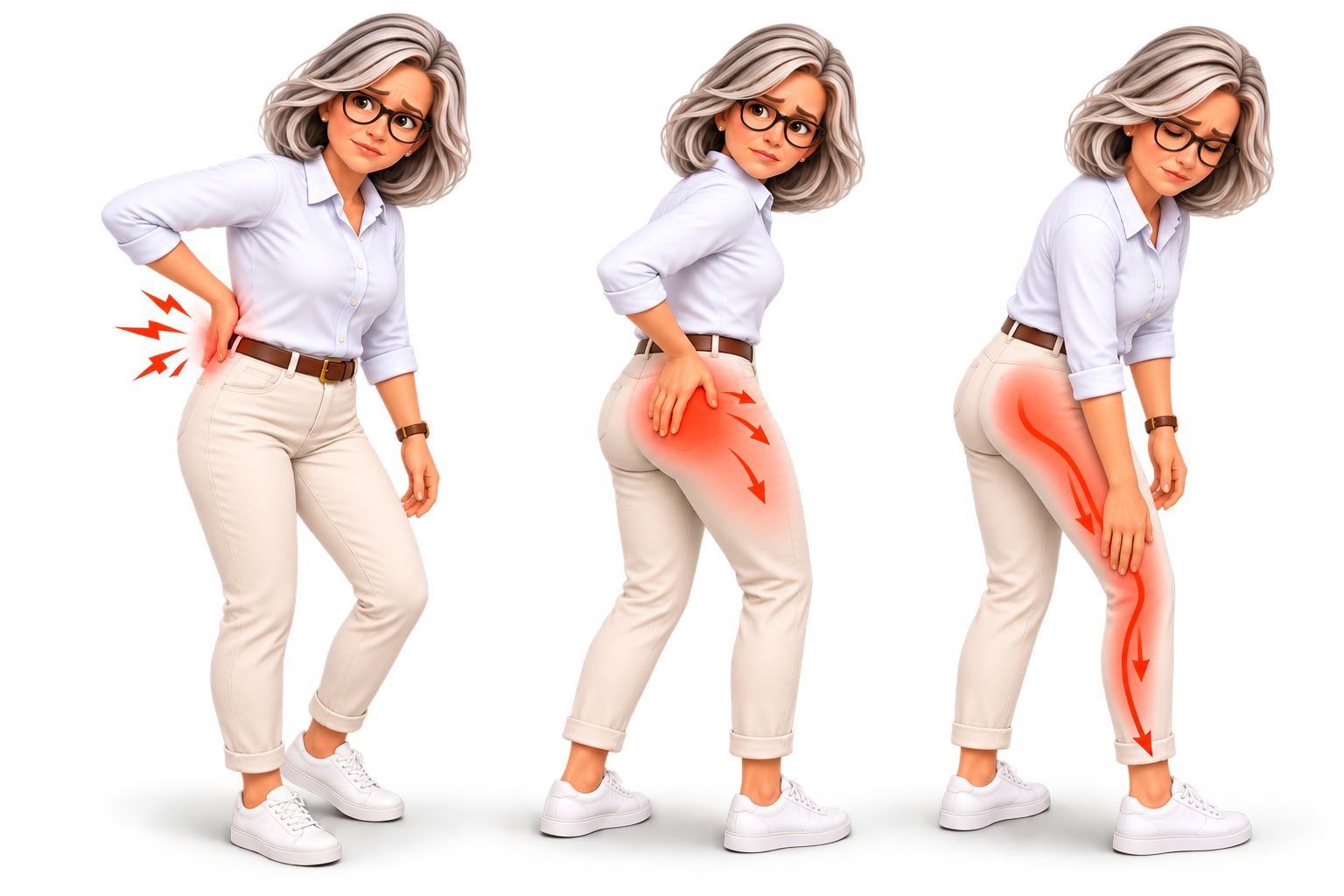
“I feel it in my lower back, but also my glute and hip. It’s pinpoint pain one moment and vague the next, like it’s everywhere and nowhere at once. Help!”

You’re not alone! Lower back problems are often felt around the buttocks and hip, and sometimes further down the leg. They can also feel surprisingly difficult to pinpoint.
Aching, stiffness and pain can be vague and spread out, then suddenly feel very focal or sharp with movements like rising from sitting, bending or turning over in bed.
The pattern can feel confusing, but it gives us useful clues. We can help you make sense of it.
2. I’m worried about what’s causing it

“I don’t think it’s anything too serious, but I'm not sure. Dr Google suggests it could be a disc or nerve root problem. What do you think?”

It’s completely reasonable to wonder if there’s a specific structural injury or problem driving your back pain. And it’s good to get some reassurance from a trusted health professional about how likely that is. Googling symptoms can be tricky — it has a habit of showing you the worst-case scenarios, which, while possible, are extremely rare.
The best way forward is to bring together what you understand about the problem with what a thorough assessment of your symptoms and movements reveals.
Sometimes that supports what you already suspected. Sometimes it gives you a different way of looking at the problem. Either way, having an understanding that makes sense to you is an important starting point for deciding what to do about it.
3. It just hasn’t gone away

“I thought it would have sorted itself out by now, but it just hasn’t gone away.”

Most episodes of back pain do improve with time, but sometimes things just seem to hang around longer than expected.
That doesn’t necessarily mean something is still injured or hasn’t healed properly. Pain and stiffness can stick around when the area remains sensitive and protective.
If your recovery seems to have stalled, it’s worth taking another look at what might be getting in the way. Sometimes a change in approach is all that’s needed to get things moving again.
4. I want treatment that actually helps

“I’ve had physio before and the hands-on treatment really helped. Do you do that, or is it mostly exercises?”
Absolutely. Hands-on treatment and exercise can both be useful. It doesn’t have to be one or the other.
Massage, joint mobilisation and manipulation can help settle pain and stiffness and make movement feel easier. Exercise and graded strengthening can then help build confidence and capacity as you return to normal activity.
The important part is matching the treatment to where you are in your recovery. There’s not much value in pushing heavy exercise when things are still very sore and irritable. Equally, it doesn’t make sense to stay with gentler treatment once your body is ready to do more.
5. I’m not sure what to do next

“Okay… so how do I put all of this together? How do I know what’s actually going on, where I’m at in my recovery, and what I should be doing about it?”
Knowing where you’re at is key.
If your symptoms are gradually settling and you’re becoming more comfortable moving and getting back to normal activity, you may not need to do much more than keep going.
But if you’ve given it some time and things aren’t progressing as you’d hoped, it’s worth taking a closer look. Your symptoms, your understanding of the problem, your stage of recovery and what your body can currently tolerate all help work out what makes sense from here.
From there, you can put together a plan that matches what you need now. That might mean settling things down, getting moving again, building strength and capacity, or progressing back towards the things you want to do.
